
Agents Are Necessary for Viability
For years, the operating stack of a small physical business has been a human being with a clipboard, a POS, and fourteen browser tabs. By 2036, we believe an operator without AI agents will look like a 2026 operator without a POS: technically possible, probabilistically doomed.
With prime costs (food plus labor) needing to stay at or below ~60% of revenue to be profitable — and losing operators consistently running above 65% — the margin between survival and failure is a handful of points.1 Those points hide in exactly the places humans are worst at monitoring continuously: vendor price creep, ordering errors, labor scheduling drift, invoice discrepancies, waste. Agents don't get tired at 11pm on a Sunday, and they check every invoice, every time.
Who's building it. Kintow, founded by Ivan Romero — who opened his own cafe during COVID and later led product at 85-location Blank Street — is building what it calls an AI copilot for restaurants: voice-based inventory counts ("5 cases of oat milk," spoken, logged instantly), real-time food-cost tracking, automated vendor ordering, invoice scanning, and alerts when ingredient prices spike.23 Kintow's stated design goal is orchestration rather than another dashboard to babysit — you notice it "in the work you never have to do again."2 It's an a16z speed run company, and its first-principles focus on back-office economics (rather than just phone answering) is exactly where we think agent value concentrates first.4
Square managerbot

Ivan Romero - CEO & founder of Kintow
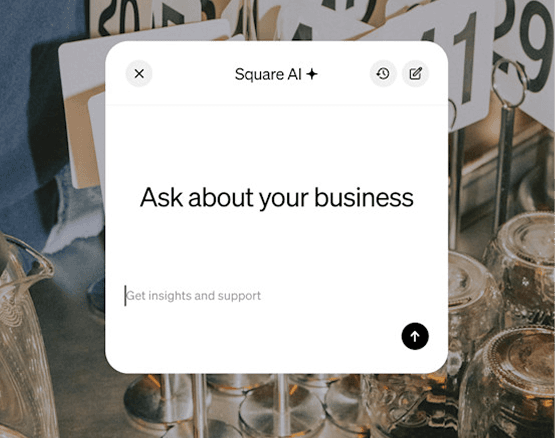
The incumbents agree. As one example, Square (full disclosure: a partner of Homegrown) is building agents on both sides of the counter. Inside the business, Managerbot went to open beta in April 2026. It's an agent built into the Square Dashboard that watches sales and labor by location, flags inventory shortfalls before a shift, builds staff schedules from sales forecasts, and drafts marketing campaigns. It suggests each action and the seller approves it. Facing customers, Square launched ChatGPT and Claude integrations in July. Diners can browse menus, order and pay inside the AI chat, and the orders flow straight into the seller's existing Square system with no setup and no marketplace commission.
Emerging players like Owner.com are also building agent-first experiences. Billing themselves as the "AI CMO and CTO" for independent restaurants, it builds and runs each restaurant's website, online ordering, branded app, CRM and marketing, and its AI answers phones, takes orders, creates promotions and responds to reviews around the clock without a human. The model is working: Owner passed $100M in ARR and raised $240M at a $2.3B valuation in August 2026. It now plans to take the same system to salons, spas and independent grocers. CEO Adam Guild's framing: AI that does "the jobs many small business owners have never been able to afford."
Yet another example comes from Thanx, a loyalty and guest-engagement platform for restaurant brands. Thanx is turning its CRM data into agents that run marketing on their own. ThanxAI launched in September 2025 with agents that the company describes as "virtual employees." Given a business goal, they pull from 200+ guest attributes to build targeted segments and plan campaigns.
In one telling pilot, Taco Bell franchisee Charter Foods asked an agent to identify stores that should stay open later; late-night sales rose 20% off its recommendations.5 Meanwhile, YC-backed Zavo is building an "agentic POS" from scratch — finance agent, manager agent, customer agent — with 400+ businesses onboard within months of launch, and Palona AI (founded by ex-Meta/Google AI leaders) has partnered with Goodcall to turn the restaurant phone line into a POS-integrated, revenue-generating AI channel in English and Spanish, 24/7.7 What a time to be alive.
The 2036 picture. Every sub-100-unit brand runs a small staff of agents: a procurement agent negotiating and ordering, a finance agent forecasting cash daily, a labor agent building schedules against demand curves, a guest agent handling most phone calls and follow-ups. The GM's job evolves from doing this work to supervising it (see Wave 3). Critically, this is the great leveler: agents give a 6-unit brand the analytical infrastructure that only 600-unit brands could afford in 2020. We are seeing operators do all of this today already, and we can already see statistically significant and positive results in their performance data.
dfasfdsds

THE TAKEAWAY
Agent adoption will become a legible underwriting signal. Two brands with identical menus and identical AUVs will diverge 300–500 basis points on prime cost purely on operational tooling. When we ask an operator "who checks your invoices?", the answer we want to hear by 2028 is the name of the agent pod and the human being supervising them.
Sources
DirectOrders / National Restaurant Association prime-cost benchmarks — https://www.directorders.com/blog/restaurant-failure-rate
Kintow — https://www.kintow.com/ and https://www.kintow.com/about-us
HNGRY, "Kintow Empowers GMs With Intelligent Copilots, Bucking AI Agent Hype" (Oct 2025) — https://www.hngry.tv/articles/kintow-empowers-gms-with-intelligent-copilots-bucking-ai-agent-hype/
a16z speedrun company profile: Kintow — https://speedrun.a16z.com/companies/kintow
Nation's Restaurant News, "The hot new restaurant tech trend: AI agents" (April 2026) — https://www.nrn.com/restaurant-technology/the-hot-new-restaurant-tech-trend-ai-agents
Y Combinator, Zavo (F25) — https://www.ycombinator.com/companies/zavo
Business Wire, "Palona AI and Goodcall Partner to Power Goodcall for Restaurants" (Nov 2025) — https://www.businesswire.com/news/home/20251113015712/en/


GMs Become Localized Pro Athletes
Next Trend