Financing + Capital
How to Choose the Right Financing for Your Next Storefront
Ian Gloer
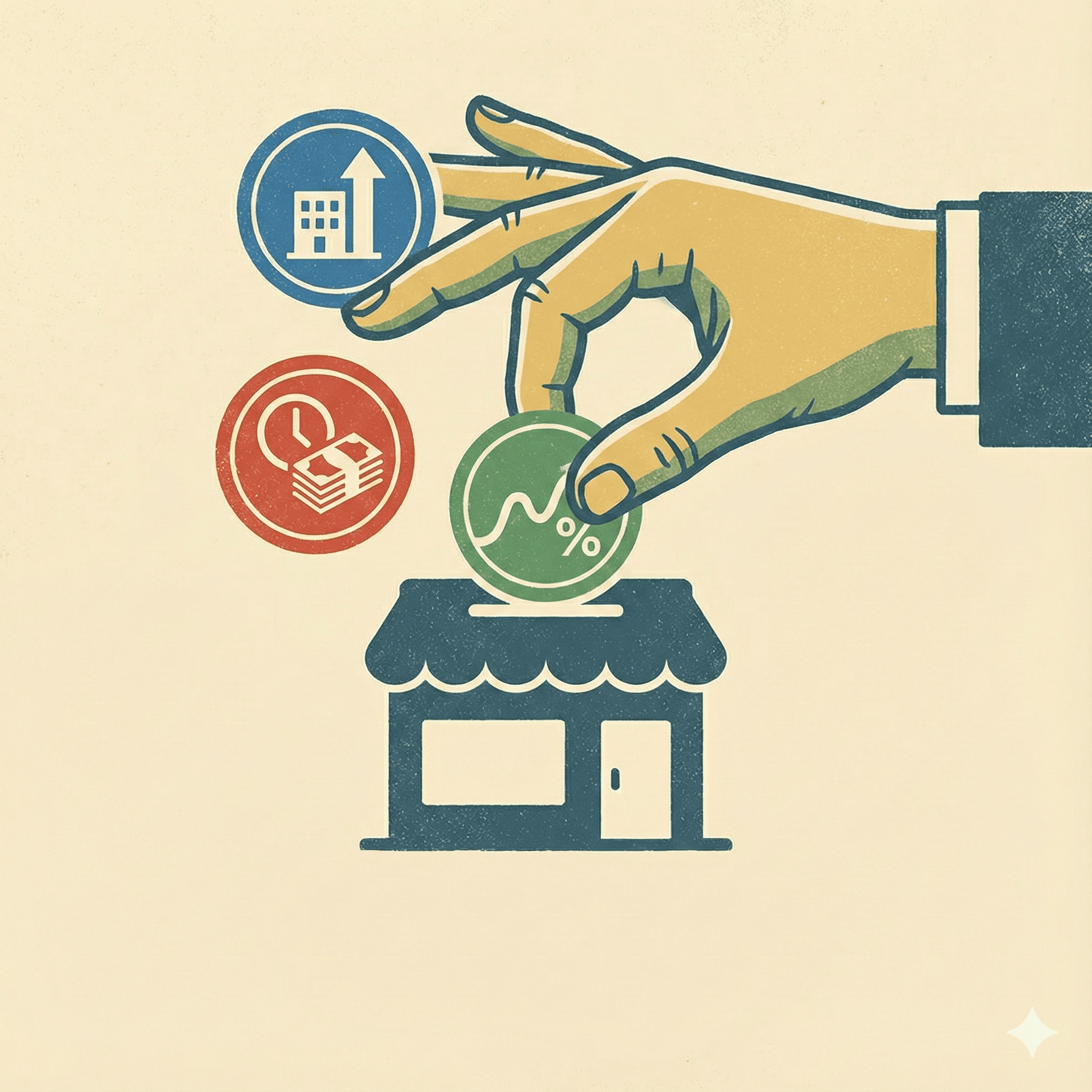
You've found the space. You've run the numbers. You know what the buildout will cost. Now comes the question that keeps most brick-and-mortar founders up at night: How do I pay for this?
The financing decision you make now will shape your business for years. Choose the wrong structure, and you could be making crushing payments before your new location ever turns a profit. Choose the right one, and you give yourself the runway to actually succeed.
Here's how to think through your options and pick the structure that fits your business.
Start with Your Business Model, Not the Financing Options
Most operators approach financing backwards. They look at what's available and try to make something work. But the right financing structure flows from how your business actually operates.
Ask yourself these questions first:
How predictable is your revenue? If you run a coffee shop with consistent daily sales, you can handle fixed monthly payments. If you run a seasonal retail business that does 60% of revenue in Q4, you need flexibility.
How long will it take to reach profitability? A fast casual concept might hit break-even in six months. A full-service restaurant might take twelve. Your financing needs to give you enough runway to get there without crushing your cash flow.
What's your margin profile? High-margin businesses (think boutique retail with 60% gross margins) can afford higher financing costs than low-margin businesses (like grocery stores operating at 10% margins).
How stable is your existing location? If your current business is already strained, taking on aggressive debt will only amplify the pressure. You need financing that gives you breathing room, not additional stress.
The structure that works for your business might not work for someone else's. And that's the point.
Understand the Real Cost of Each Option
Every financing option has a price. Sometimes it's obvious, like an interest rate. Sometimes it's hidden, like giving up equity or agreeing to personal guarantees.
Here's what to look for beyond the headline number:
Cost of capital. If you borrow $300,000, how much will you actually pay back over the life of the agreement? Different terms and interest rates can have a dramatic effect on the total cost you pay. Be sure to account for things like origination fees, guarantee fees, and other ongoing fees you may be charged.
Payment frequency. Fixed monthly payments work differently from revenue-based payments. Does the deal have daily, weekly, or monthly payments? Are payments fixed or variable? Is there an interest-only period or any kind of balloon payment? All of these should be evaluated and considered.
Timeline. A three-year payback creates different pressure than a seven-year payback. Shorter timelines mean higher payments but less total interest. Longer timelines mean lower payments but more total cost. The key is to find the right balance between total cost and payment amount that works for your business.
Collateral and guarantees. Are you pledging your equipment, your home, or your personal assets? What happens if the business struggles? Some financing puts only the business at risk. Other financing puts you personally on the hook.
Flexibility. Can you pay off the financing early without penalty? Can you adjust payment timing if you hit a rough patch? Some structures lock you in. Others give you room to maneuver.
Calculate the total cost over time, not just the monthly payment. That's the only way to compare options accurately.
This is where most operators get tripped up. They focus on whether they can afford the payment on average, but they don't think about whether they can afford it during a bad month.
If your business generates $50,000 in revenue most months but drops to $30,000 in January and February, can you still make a $4,000 fixed payment? If not, you need a structure that flexes with your revenue.
Revenue-based financing solves this problem. You pay a percentage of monthly sales, so when revenue drops, your payment drops too. When revenue is strong, you pay more and pay down the funding faster.
Fixed payment structures work well when revenue is predictable. But if your business has seasonal swings, variability, or a long ramp period, fixed payments can become a crisis during slow months.
One operator we know took on a merchant cash advance with daily payments. The funding came fast, but within three months, they were struggling to cover the daily withdrawals during a slower-than-expected ramp. They ended up refinancing at a higher total cost just to get some breathing room.
Don't just model the average case. Model the worst case, and make sure your financing structure can handle it.
Match Payment Structure to Cash Flow Patterns
This is where most operators get tripped up. They focus on whether they can afford the payment on average, but they don't think about whether they can afford it during a bad month.
If your business generates $50,000 in revenue most months but drops to $30,000 in January and February, can you still make a $4,000 fixed payment? If not, you need a structure that flexes with your revenue.
Revenue-based financing solves this problem. You pay a percentage of monthly sales, so when revenue drops, your payment drops too. When revenue is strong, you pay more and pay down the funding faster.
Fixed payment structures work well when revenue is predictable. But if your business has seasonal swings, variability, or a long ramp period, fixed payments can become a crisis during slow months.
One operator we know took on a merchant cash advance with daily payments. The funding came fast, but within three months, they were struggling to cover the daily withdrawals during a slower-than-expected ramp. They ended up refinancing at a higher total cost just to get some breathing room.
Don't just model the average case. Model the worst case, and make sure your financing structure can handle it.
Factor in Ramp Time and Growth Trajectory
New locations don't hit full revenue on day one. There's always a ramp period where sales start low and gradually build.
If you're opening a second location in a new neighborhood, it might take three to six months to build awareness and regular traffic. If you're entering a new market entirely, it could take even longer.
Your financing needs to account for this reality. If you take on a structure that assumes full revenue from month one, you're setting yourself up for a cash crunch.
Look for financing that either:
Delays payments for the first few months while you ramp up
Starts with lower payments that increase over time as revenue grows
Ties payments directly to revenue so they naturally stay low during the ramp period
The worst-case scenario is taking on aggressive daily or weekly payments that assume strong revenue immediately. We've seen this kill promising expansions before they ever get off the ground.
Consider Your Growth Plans Beyond This Location
If this is your second location and you're planning to open a third in 18 months, think about how this financing decision affects that timeline.
Some financing structures limit your ability to raise additional capital later. Others don't. Some capital providers will want to be involved in future rounds. Others are hands-off.
Equity is the most restrictive. Once you give up 20% of your business, that 20% is gone forever. If you need to raise again for location three, you're either diluting yourself further or limiting how much you can raise.
Debt is more straightforward. You borrow money, you pay it back, and then you're free to do it again. But if you're already carrying heavy debt from location two, your ability to borrow for location three may be limited.
Revenue-based financing sits in between. You're not giving up ownership, but you do have an ongoing payment obligation until the funding is repaid. The key is making sure your payment percentage is low enough that it doesn't prevent you from accessing additional capital when you're ready.
Think two or three steps ahead. This financing decision isn't just about getting location two open. It's about setting yourself up to keep growing.
Evaluate the Capital Provider, Not Just the Capital
The terms matter. But so does who's on the other side of the table.
Some capital providers understand brick-and-mortar businesses. They know that ramp periods happen, that buildouts run over budget, and that Q1 is slower than Q4 for most retail concepts. They've seen it before, and they structure deals accordingly.
Other capital providers are just running an algorithm. They don't care about your business model or your growth trajectory. They care about whether the math works for them.
Ask yourself:
Does this capital provider have experience with businesses like mine?
Are they flexible if things don't go exactly as planned?
Can I reach a human when I need to talk through something?
Do they understand the realities of opening a new location, or are they just looking at a spreadsheet?
The best capital providers act like partners. They want you to succeed because your success is their success. The worst ones just want to get paid, and they'll make your life difficult if you hit a rough patch.
At Homegrown, we've built our entire model around understanding brick-and-mortar operators. We know what it takes to expand, and we structure deals that give you the flexibility to actually succeed. If you're evaluating options, we'd love to talk through your situation.
Know When to Walk Away
Sometimes the answer is that none of the available financing options make sense for your business right now.
Maybe the payment structures are too aggressive. Maybe the total cost is too high. Maybe the capital providers don't understand your business well enough to structure a deal that works.
We've worked with operators who walked away from financing that felt wrong, waited six months, improved their numbers, and came back to better terms. We've also seen operators who forced a deal that didn't fit and regretted it within a year.
If the financing doesn't support the business you're trying to build, don't take it just because it's available.
What Works for You
Choosing the right financing isn't about finding the cheapest option or the fastest approval. It's about finding the structure that aligns with how your business actually operates.
Revenue-based financing works well for growing businesses with variable cash flow. Traditional bank loans work well for established businesses with predictable revenue. Equipment financing works well when you need specific assets. Equity works well when you need patient capital and strategic support.
There's no universal right answer. There's only what works for your business, your cash flow, and your growth timeline.
At Homegrown, we specialize in revenue-based financing for brick-and-mortar operators expanding to multiple locations. We provide up to $2 million in growth capital in exchange for a small percentage of monthly sales, typically 1% to 6%. Payments flex with your revenue, so you're never stuck making fixed payments when business slows.
If you're evaluating your financing options and want to talk through what makes sense for your situation, reach out. We're here to help you grow on your terms.

How to Evaluate Your Projected ROI Before Taking on Capital
Next Article