Budgeting + ROI
What’s the Average Cost to Open a Storefront, and How Can I Afford It?
Michael Davis

If you’ve ever tried to open a storefront, you already know the punchline: it’s going to cost more than you think.
Every operator walks into a project with a number in mind. Then the plumbing needs to be replaced, the permits take longer, and the furniture order shipping fees double. The total creeps up quietly until it’s twenty or thirty percent higher than the best-case scenario. It happens to everyone.
The question isn’t whether you’ll go over budget. The question is how prepared you are for when it happens.
The Real Cost of Opening a Storefront
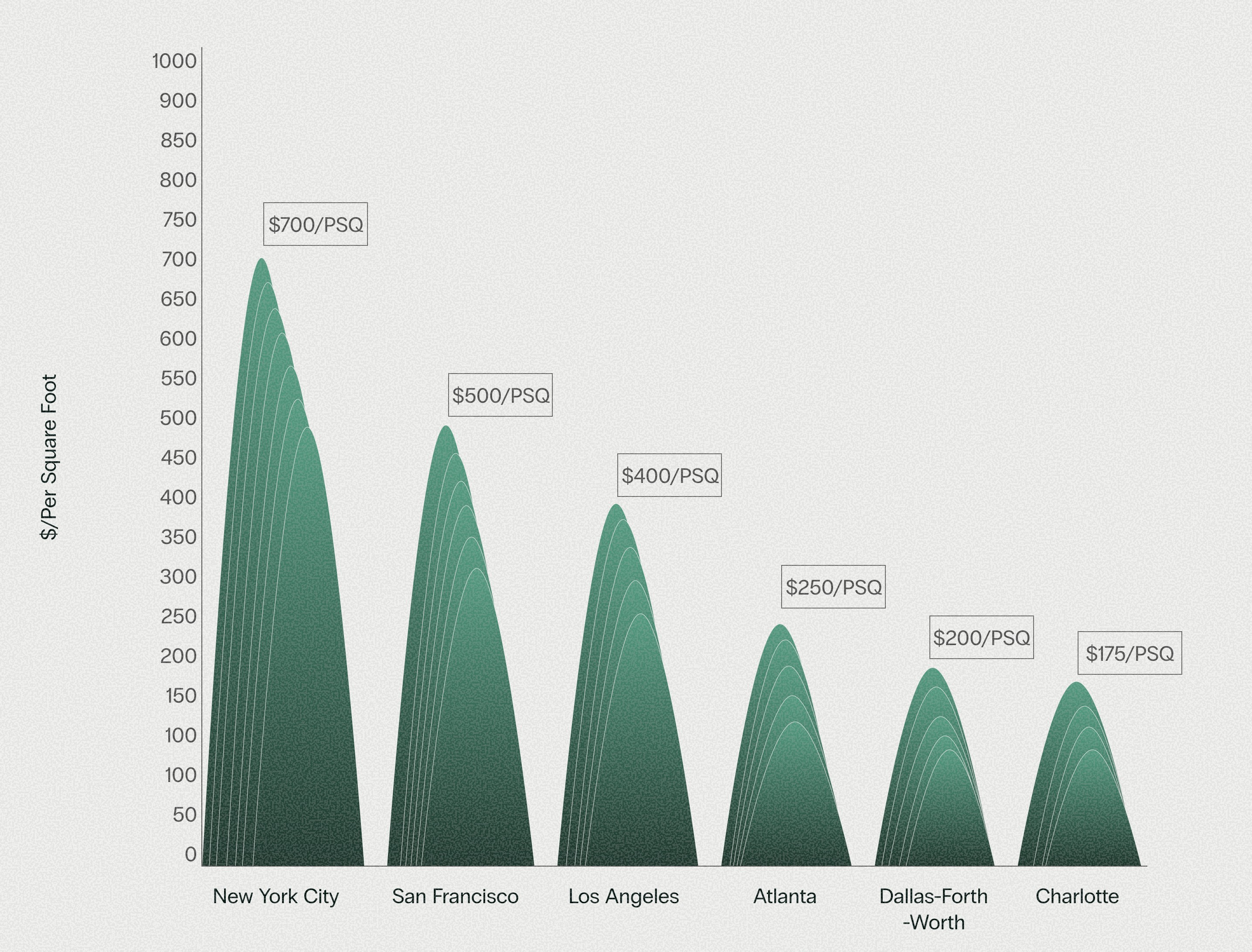
Depending on the market, opening a single location can range drastically $90,000 to $6,000,000. But that’s only the starting line.
New York City: $300–$700 per square foot for buildouts, plus rent that can exceed $100 per square foot annually in areas like SoHo or the West Village.
San Francisco: $200–$500 per square foot for construction, with average rents between $60 and $80 per square foot.
Los Angeles: $150–$400 per square foot, depending on whether you’re in a coastal neighborhood like Santa Monica or a growing area like Highland Park.
Atlanta: $100–$250 per square foot for buildouts, with rents typically $25–$40 per square foot.
Dallas-Fort Worth: $100–$200 per square foot for construction, and commercial rents around $20–$35 per square foot.
Charlotte: $75–$175 per square foot for buildouts, with rents generally $25–$30 per square foot.
These ranges include buildout, permits, design, signage, and the first few months of rent. What they don’t include are the surprises, and there will always be surprises.
If you think your project will cost $250,000, plan for $300,000 or more. A safe rule of thumb is to build in at least a 20–30% buffer. The best operators plan for reality, not perfection.
What to Include in Your Budget
Every storefront budget should cover five major areas:
Buildout and equipment: Construction, design, and fixtures.
Licenses and permits: Local fees, inspections, and approvals.
Initial inventory: The products or supplies you need to open.
Marketing and signage: How you’ll let people know you exist.
Working capital: Payroll, rent, and overhead until the business becomes profitable.
A financial model can help you see the path forward, but it’s still just a model. Costs shift, delays happen, and revenue rarely ramps exactly as planned. The more cushion you have, the less stress you’ll carry through the process.
How to Pay for It
Opening a new location is expensive, but it doesn’t have to drain your savings or require personal guarantees. There are several ways to fund a buildout, each with tradeoffs to consider.
Equity funding: Bringing in investors or partners in exchange for ownership.
Traditional bank loans: Useful but often slow and heavily underwritten.
SBA loans: Helpful if you qualify, but backed by personal guarantees.
Revenue-based financing: Flexible capital that scales with your sales and lets you keep your equity.
The right structure depends on your business model, stage of growth, and risk tolerance. What matters most is that the capital fits your reality, not the other way around.
How Homegrown Fits In
At Homegrown, we provide up to $2 million in growth capital for multi-location brick-and-mortar entrepreneurs. We back proven operators who are ready to expand while staying in control of their business.
Our model is simple. You get capital today in exchange for a small percentage of monthly sales, usually 1–6%. Payments adjust with your revenue, which means you’re never stuck making fixed payments if (and we really hope it doesn’t!) business slows.
Here’s what makes our model different:
No personal guarantees: Your business stands on its own.
Larger checks: Enough to open one to three new locations, not just cover short-term gaps.
Keep your equity: Stay in control of your vision and decisions.
Early payment discounts: Pay off your financing early in one lump sum, and you can save on the total cost.
Opening a storefront will always cost more than you expect. That’s the nature of growth. The key is to plan for the inevitable surprises and surround yourself with partners who’ve been there before.
Expansion is hard enough. Your funding options shouldn’t make it harder. If you’d like to learn more about how Homegrown can support your next stage of growth, apply for funding or subscribe to our newsletter for more insights.
How To Pick Your Next Location
Next Article